Jory MacKay on April 01, 2026
 How to reduce context switching — and boost your productivity
We’ve all had those days: You sit down at 9:00 with a clear plan for the day, but just as you’re getting into the flow, someone emails you, invites you to a meeting, or taps on your shoulder.
Context switching — regularly getting pulled from one task to another — doesn’t only eat up your time, but also your energy, attention, and motivation.
A recent study found that 43% of workers feel that context switching causes exhaustion and prevents us from making progress on “real work”. Reducing context switching can give you back a meaningful chunk of your day, provide more focus for deep work, and even boost creativity.
In this guide, we’ll explain why context switching is taking over your day, how to overcome it, and ways to rebuild your “focus muscle” over time.
Jump to a section:
What is context switching? What causes it?
Context switching is the act of jumping between unrelated tasks. While being able to juggle a varied workload is a core skill for any profession, constant context switching takes up a lot of energy that reduces productivity and increases exhaustion.
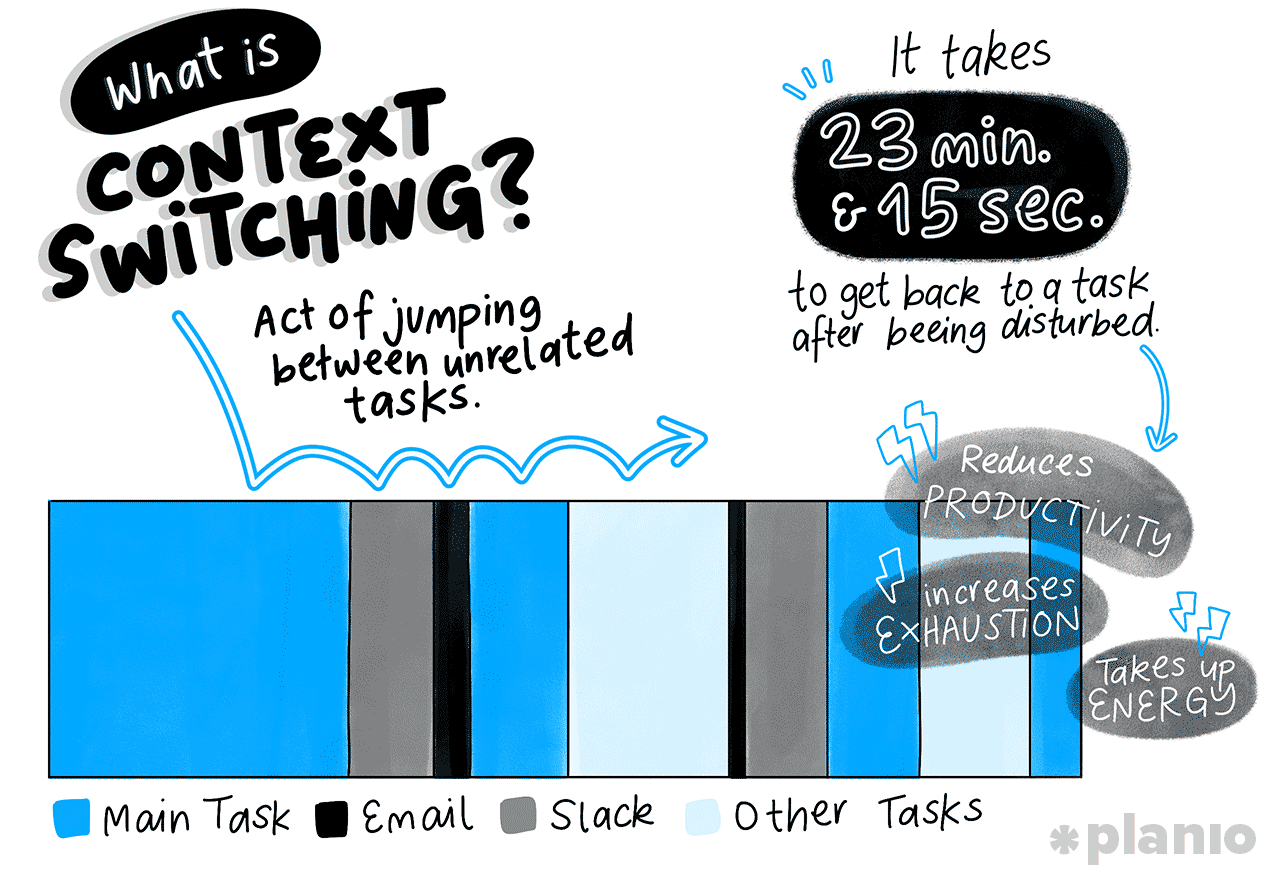
Even brief distractions can derail knowledge workers. Studies found it takes an average of 23 minutes and 15 seconds to get back to the task after being distracted.
The hardest thing about tackling context switching is understanding when, and how often, it happens.
Here’s a real-life example of what context switching could look like during your workday:
- You start your day motivated to work on an important upcoming status report
- But ten minutes in, you receive an email notification about a client issue
- You “switch contexts” from deep thinking and report writing to handling the email
- But while drafting a response, you receive another notification about a “high priority” ticket in your project management system
- You switch to your PM tool (context switch #2) to tackle the issue before returning to the client email (context switch #3)
- By the time you return to the report (context switch #4), you’ve lost your train of thought and need to take extra time to get back into the right headspace
In this example, all of these tasks are important and need your attention. But by bouncing between one and the other, all of them suffer. Unfortunately, for many people, this is just what the modern working world looks like.
Studies found it takes an average of 23 minutes and 15 seconds to get back to the task after being distracted.
Context switching has become so much the norm that it’s uncomfortable to sit in a quiet room and “monotask”.
But context switching isn’t just a symptom of having too many priorities. In our day-to-day lives, the most common causes of context switching also include:
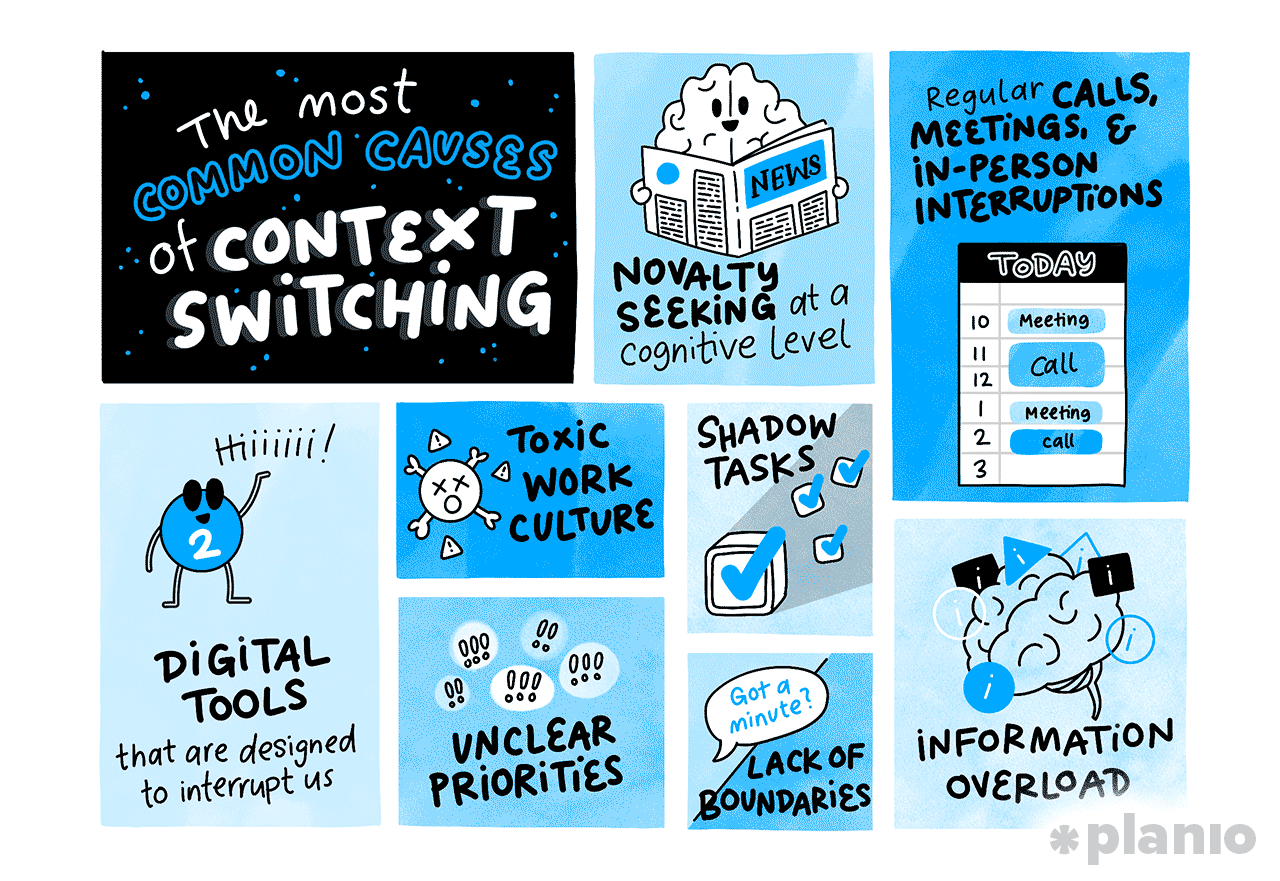
- Digital tools that are designed to interrupt us. Notifications, pings, and red banners trigger dopamine hits that distract our brains. Modern tools are cleverly engineered to pull us away from other work.
- Regular calls, meetings, and in-person interruptions. Back-to-back schedules leave only 15-minute gaps of free time, which is never enough to enter a focused flow state.
- Unclear priorities. When everything is a “top priority”, we tend to jump to the newest task rather than focus on the most important one.
- Toxic work cultures. When your work culture rewards responsiveness over output, you’re more likely to get distracted and feel compelled to be constantly available. In short, you end up prioritizing quantity over quality.
- Novelty seeking at a cognitive level. The human brain is a novelty-seeking tool. But the more we rely on quick hits of dopamine or distraction-led days, the more our brains seek out novelty (i.e., new tasks, updates, and news).
- Information overload. We’ve never had access to more information, but our brains can only handle so much. Information overload can clutter your brain and cause you to find it hard to focus on one thing at a time.
- Lack of boundaries. Working without defined focus hours tells your team that you are always available for a quick chat. While it’s great to be available, it can come at the cost of productivity.
- Shadow tasks. Shadow tasks are undocumented, tiny requests that happen in direct messages and eat up cognitive energy without ever making it to a real to-do list. These silent context switchers eat away at the little spare time you already have to play with.
But what’s the bottom line here? Context switching is a systemic issue fueled by our tools, company culture, and personal habits. To “fix it”, we have to step back and recognize the underlying causes, and then redesign how we approach our workday.
The true costs of context switching
By now, you’re probably starting to recognize the triggers in your own life that cause you to switch contexts. But what’s the real impact of switching between tasks if they’re all important to your job?
Reducing context switching can give you back a meaningful chunk of your day.
While some context switching is unavoidable, excessive and prolonged context switching can seriously impact you in a number of negative ways, including:
- Lower productivity: You spend so much energy “loading and unloading” tasks that your actual output plummets. Even if you do get your next task ticked off, you’re unlikely to do a top-quality job.
- Increased stress and anxiety: The constant low-level panic of trying to keep too many plates spinning leads to frenetic exhaustion. Left unchecked, this can quickly turn into project management burnout.
- Analysis paralysis: By mid-afternoon, your mental reserves are drained, making complex decision-making nearly impossible. This analysis paralysis means projects don’t move forward, leaving everyone stuck in the mud.
- Inability to hold focus: The more you switch, the harder it becomes to concentrate on a single task for more than a few minutes. If we don’t exercise our concentration muscles it’s easy to lose that skill altogether.
- Low energy and motivation: It’s hard to feel excited about work when you never get the satisfaction of finishing a major task. This snowballs into lost motivation, increasing your chance of seeking out a new role.
- Confused priorities: If you’re bouncing around, it’s easy to lose sight of long-term goals. Not being able to see the wood from the trees is dangerous, as you may end up tied in knots that need to be unpicked.
But is there light at the end of the tunnel? Yes, there absolutely is! Spending time on deep work is incredibly rewarding. It provides a sense of mastery and meaningful progress. Plus, the more you practice working without distraction, the easier it becomes to focus in the future.
How to reduce context switching and regrow your “focus muscle”
To get back into the flow, you need to be tactical. Reducing context switching isn't just about trying harder to ignore distractions; it's about systematically redesigning how we manage each day to remove distractions and create space for focus. \
Here are some tactics to help you reshape your routines to minimize interruptions and maximize meaningful output.
1. Follow a consistent prioritization framework
When everything feels urgent, our natural instinct is to bounce between tasks, hoping to keep all the plates spinning at once. To combat this, we need a reliable framework to decide what actually deserves our attention at any given moment.
Actions to help:
- Practice prioritization: Implement a prioritization framework to help you decide what is and isn’t important. Frameworks such as RICE (Reach, Impact, Confidence, Effort) can be easily adapted for any situation to help you choose the things that are most important.
- Define daily goals: Start your morning by identifying your "top 3" tasks for the day. If a new request comes in that doesn't trump those three, it doesn't get your immediate focus.
2. Create a “task repository” to capture ideas and issues
Our brains are fantastic at generating ideas but terrible at holding onto them while we focus on something else. If we don’t have a trusted place to dump stray thoughts or sudden requests, they end up cluttering our minds or pulling us completely off task.
Actions to help:
- Create a “Task Holding Area”: When an idea comes into your head, capture it and save it for later. To achieve this, use a notepad tool (such as Planio’s Wiki) open as your dedicated repository. When a random idea hits you, log it quickly as a new ticket, assign it no immediate due date, and close the window.
- Set aside idea development time: Schedule a 15-minute block at the end of your day to review this repository and properly schedule or assign the tasks you captured using a task management tool.
3. Use time blocking to protect your focus time
If we leave our schedules open and default to reacting to others, we will never find the uninterrupted time required for meaningful work.
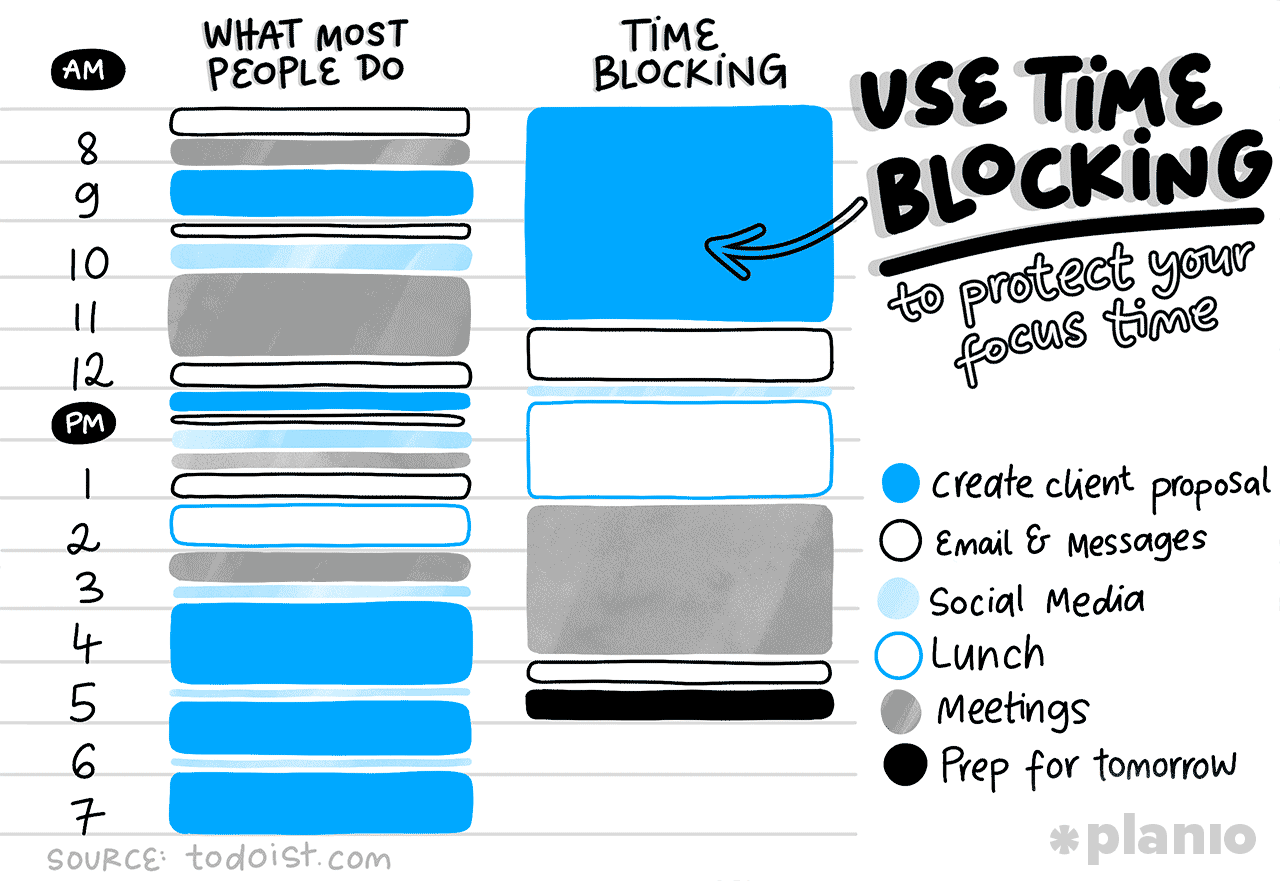
Time blocking flips the script by allowing you to proactively assign specific blocks of your day to specific tasks. Treating these blocks with the exact same respect as a meeting with a client or your boss is crucial for actually getting things done.
Actions to help:
- Learn more about time blocking: Check out the Planio Guide to Time Blocking to give you all the tips and tricks you need to implement time blocking.
- Communicate with your team: When getting started with a productivity system like time blocking, it’s important to share your plans with your team. That way, they’ll know when not to contact you, removing the chance of distractions.
4. Create rituals around your protected deep work time
Transitioning from a chaotic inbox to a state of deep concentration doesn't happen at the snap of your fingers. We need to actively signal to our brains that it's time to shift gears and block out the noise. Establishing a simple, repeatable pre-work ritual helps bridge that gap and trains your mind to drop into focus mode much faster.
Actions to help:
- Set up a physical cue: Create a physical trigger for your focus time, such as putting on noise-canceling headphones, brewing a specific type of tea, or moving to a different chair.
- Practice the Pomodoro technique: Use the Pomodoro Technique (working in focused 25-minute intervals) to ease yourself into deep work if you are struggling to concentrate for long stretches.
- Combine the two: For the best results, combine a physical cue and Pomodoro. For example, I use Pomodoro alongside calming, classical music to get into a deep focus with regular rests to recharge and go again.
5. Use tools to plan your tasks and projects
One of the biggest hidden causes of context switching is simply trying to find the information you need to do your job. When project details are scattered across emails, spreadsheets, and chat threads, you lose momentum and open yourself up to distractions.
Pro tip: Planio’s project management tool is perfect to use as your single source of truth.
Planio’s flexible knowledge and task management system ensures that all conversations, files, and updates live directly inside the relevant task issue, saving you from jumping around to different places.
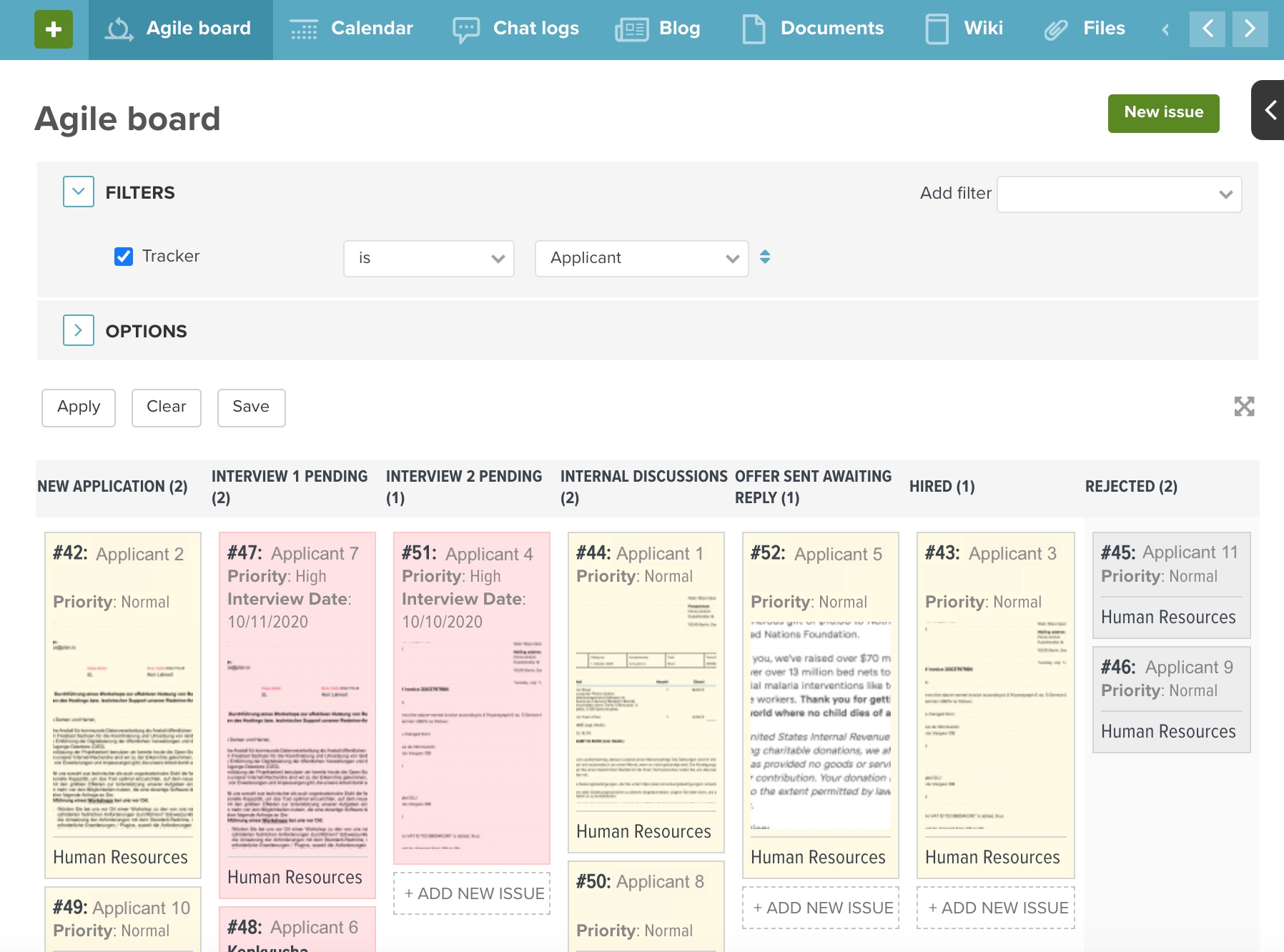
Planio has a range of apps for Agile and waterfall projects, including task management, Gantt charts, Kanban boards, documents, wikis, and even integrations with code repositories, so it really is the one place for all of your project needs.
6. Prioritize asynchronous communication
Real-time chat apps are fantastic for urgent issues, but they can become productivity killers when used for everyday project updates.
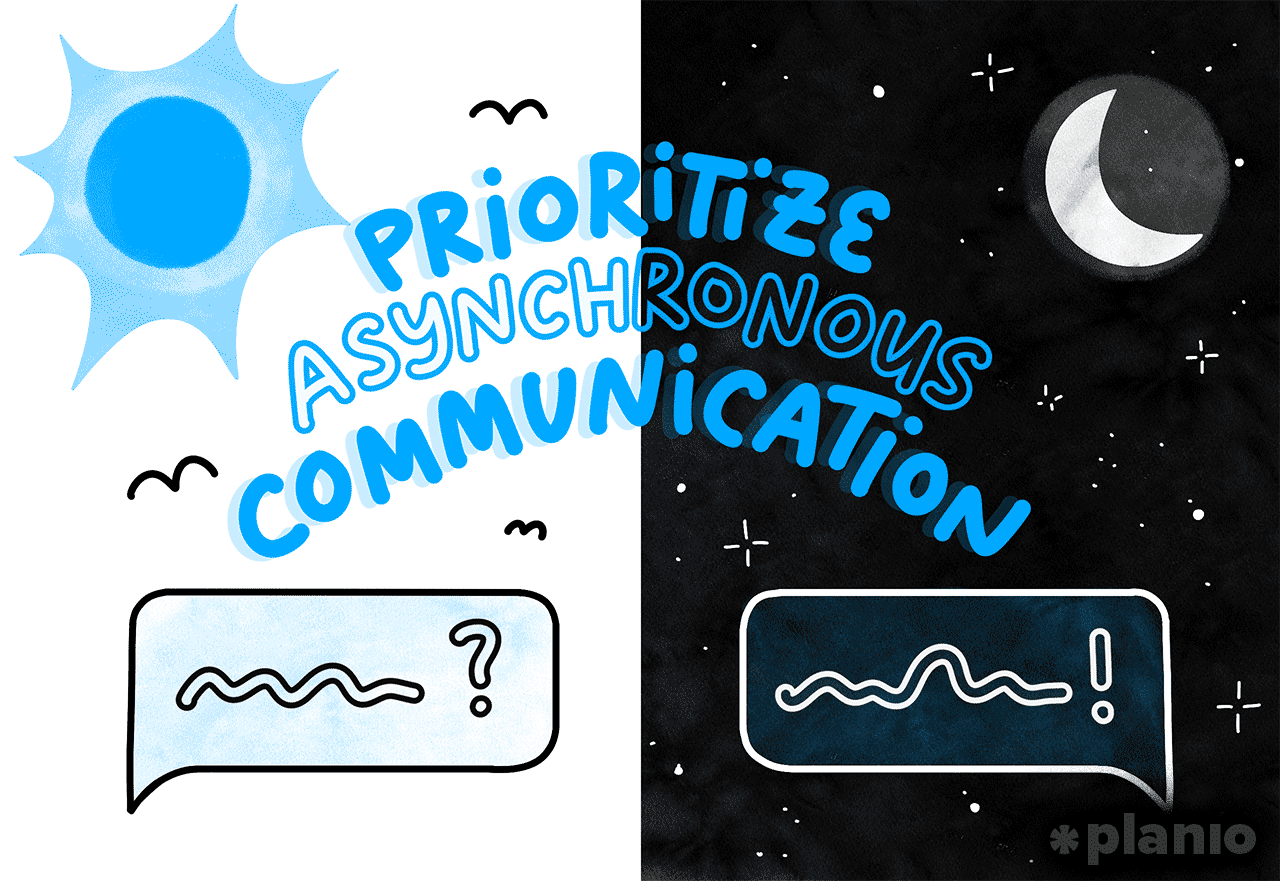
The expectation of an immediate reply forces everyone into a reactive state, constantly breaking their concentration. Shifting to asynchronous communication means you communicate thoughtfully and respond when it suits your schedule.
Action to take:
- Switch up the system: Set an example for your team by moving standard project updates and non-urgent questions out of chat and into your project management tool. That way, you and your team can consume updates on their terms.
- Agree on new ways of working: As a team, agree on a realistic “Response Time Agreement” (e.g., agreeing that internal emails will be answered within 24 hours, not 24 minutes) to set a culture that discourages context switching and focuses on productivity.
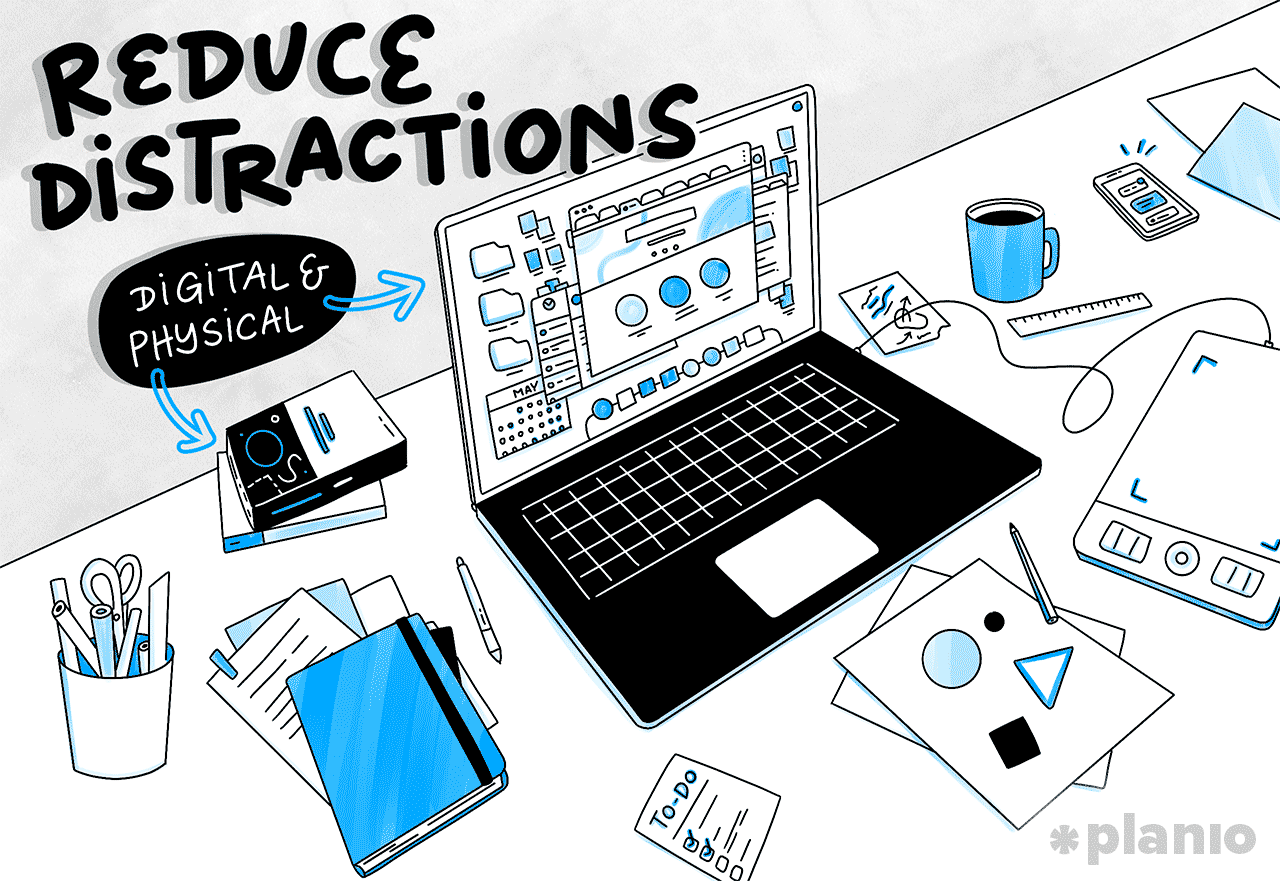
7. Reduce digital and physical distractions
Willpower is a finite resource, and it is usually no match for software that is designed to capture your attention. Rather than relying on discipline to ignore pings and pop-ups, actively curate your digital and physical environment to maximize focus.
Actions to take:
- Go through a “Digital Detox”: Turn off all desktop and mobile push notifications for your non-essential work apps. If an issue is truly a critical emergency, someone will call you.
- Clean up your physical space, too: Physical tidiness is a big enabler of productivity. In a recent study, 41% of workers believed a tidy workspace made them more productive, and 21% admitted that having a cluttered desk increased their workload.
8. Train your focus muscle during downtime
Deep concentration isn’t a personality trait; it’s a cognitive skill that requires regular practice and maintenance.
Deep concentration isn’t a personality trait; it’s a cognitive skill that requires regular practice and maintenance.
If we spend our evenings and weekends scrolling through 15-second videos, we’re actively training our brains to crave constant context switches. Rebuilding our attention spans requires us to embrace longer, slower activities outside of working hours.
Actions to help:
- Get comfortable with monotasking: Practice "monotasking" in your personal life. Try to read a book, watch a film, or cook a meal without simultaneously checking your phone.
- Start small: If your focus is completely shot, aim for just 15 minutes of uninterrupted reading a day and slowly build your endurance back up. Remember to take regular breaks to re-energize before jumping back in.
9. Track your working hours and progress
Lastly, as you work hard to build your focus muscles, use data to inform your journey. It’s incredibly difficult to change a habit if you don’t have a clear, objective picture of your baseline behavior.
Tracking your time provides the cold, hard data needed to identify your biggest distractions and prove to yourself that your new focus habits are working.
Actions to help:
- Take advantage of Planio’s time-tracking feature: Use the Planio built-in time tracking feature to log exactly how long tasks are actually taking you, identifying where context switching is slowing you down.
- Reflect, adapt, and improve: At the end of the week, review your tracked time. Seeing a solid block of hours dedicated to a high-priority task is a fantastic motivator to keep your focus habits going strong.
Why most people can’t stick with deep work (and what to do)
Setting up a schedule is easy; sticking to it when the distractions start is the hard part.
Here’s a quick guide on how to address the most common roadblocks getting in the way of your deep work:
| Roadblock | Solution |
|---|---|
| You feel “guilty” about not being always available | Document your progress to remind yourself of the importance of focus time. You can use the 80/20 rule to justify your actions here. |
| Coworkers don’t respect your deep work time | Work with your team to agree on daily “collaboration time” and set firm response time expectations outside of those bounds. |
| Managers keep switching up your priorities | Keep a stack-ranked list of priorities in Planio to show leadership the immediate impact of their choices when new work is introduced. |
| Information silos force you to app-switch | Centralize everything. Use the Planio integrations to bring your repository, communication, and files under one roof. |
| You “mess up” one day and want to give up completely | Don’t be disheartened. Disconnect and come back to your daily routines and new rules tomorrow. |
The bottom line: Give yourself permission to focus
We’ve been conditioned to believe that being “busy” is the same as being “productive”, but that couldn’t be further from the truth.
The more we reduce context switching, the more we realize that productivity isn’t about doing more things — it’s about doing the right things with your full attention.
While rebuilding your focus takes time, new habits, and even cultural shifts, one of the best things you can do for yourself and your team is create a single source of truth for project tasks and data.
Planio helps teams break free of the real-time chat trap — putting everything you need in one place, encouraging asynchronous working, and carving out the time you all need for focused work.
Give yourself permission to close the tabs, turn off the pings, and truly focus by signing up for a free 30-day Planio trial — no credit card needed!